
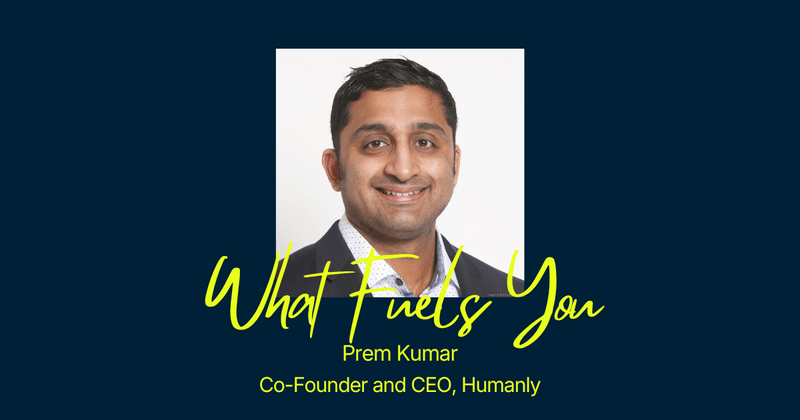
Co-Founder and CEO, Humanly
For two and a half years, Prem Kumar didn't take a single vacation. The business kept raising money and closing rounds. His mental health did not keep pace.
In this episode of What Fuels You, host Shauna Swerland sits down with Prem Kumar, co-founder and CEO of Humanly, the Bellevue-based hiring technology company he built after a decade at Microsoft. Prem talks about the side startup that failed before Humanly, the case he now puts in writing for investors before they get a board seat, and the burnout that caught up with him even as Humanly raised $52 million. What starts as a founder's resume becomes a conversation about the discipline it takes to build something at scale without losing yourself in the process.
📋 Episode Chapters
| 00:00 | Cold open and rapid-fire round: apps, best advice, and family life |
| 07:00 | Growing up first generation, from Wichita to Boeing-era Seattle |
| 11:00 | Bullying, sports, and an early pull toward technology |
| 13:00 | What being an Eagle Scout taught him about discipline |
| 16:00 | An early observation about interview bias at UW |
| 22:00 | RentMatch, the side startup that folded before Humanly |
| 23:00 | Leaving Microsoft's scale for TinyPulse's speed |
| 26:00 | Recruiting Andrew Gardner and Bryan Leptich to co-found Humanly |
| 29:00 | Humanly's original chatbot screening model |
| 31:00 | Y Combinator, equity trade-offs, and raising $52 million |
| 34:00 | Two and a half years without a vacation, and the burnout that followed |
| 39:00 | Where Humanly is headed: one interview, matched everywhere |
| 42:00 | AI agents, human capacity, and what fuels Prem Kumar today |
Ten Years at Microsoft, One Side Bet at a Time
Prem Kumar spent about a decade at Microsoft, working across HR technology, LinkedIn data integration, and other product roles. His interest in HR issues showed up early, through Microsoft's Think Week format, where any employee could write a paper on a topic and get it voted on by peers. Prem wrote his about engaging millennials in the workplace, and then-CHRO Lisa Brummel commented on it, a moment he says convinced him he was onto something. Brummel later became an advisor at Humanly.
The paper also led a Microsoft director, Ross Smith, to reach out and ask Prem to be his mentor, which turned into a formal reverse mentoring program: junior women mentoring senior male engineering leaders on how to better engage the broader workforce. Prem said that same instinct, that title and tenure don't determine who has something to teach you, carried straight into how he built Humanly's culture.
"I think part of that is realizing that anyone at the company can mentor me on something."
-- Prem Kumar
While still at Microsoft, he also built a side project mapping apartment listings against Google Maps data, an early rental search tool. It folded, largely because, as Prem put it, they figured if they built something cool people would come, which isn't how marketing or SEO works. He said learning to let go of something that wasn't working became one of the more useful skills he carried forward, and it set up his move to TinyPulse to learn the pace of startup life before starting his own company.
Betting on Recruiting Tech
Prem traces part of what became Humanly to his senior year at the University of Washington, when he and a female classmate with nearly identical resumes and internships interviewed with the same companies for the same jobs. Comparing notes afterward, they found the two candidates on paper looked interchangeable, but the interviews didn't treat them that way.
"We were being interviewed completely differently, so they would grill her on a lot of technical skills, but somehow by looking at me, they thought that I was very technical."
-- Prem Kumar
That observation sat with him for roughly a decade before he acted on it. When he did, he brought on two co-founders: Andrew Gardner, whom he'd worked with at TinyPulse and who understood the buyer side of the business, and Bryan Leptich, an engineer he'd worked with on the earlier rental project.
"So I took him to Applebee's and paid for his Applebee's dinner and convinced him to join."
-- Prem Kumar, on recruiting Bryan Leptich
Humanly started by using chatbots to move candidates past the resume, giving them a two-way conversation before a human ever got involved. That grew into full interviewing and screening at scale, the product Humanly runs today.
The Fundraising Playbook Behind $52 Million
Humanly went through Y Combinator early on, a decision Prem said he'd make again as a first-time founder but probably wouldn't repeat if he started another company, given what it cost in equity relative to what he already knows now. The bigger shift, he said, came later, after the seed round, when he changed how he thought about investors entirely.
"It was a shift from feeling like I'm lucky because they're investing, to I'm giving them an opportunity to potentially make a lot of money, and we're letting them in versus them allowing us to proceed."
-- Prem Kumar
By the later rounds, Humanly's data room spelled out expectations for investors in writing: what kind of contact was reasonable day to day, what showing up looked like during a bad quarter, and what diversity, including of skills and networks, the company wanted on its cap table. Prem said in a few cases a deal came down to how an investor responded to that framing, since some made clear they weren't going to be there through the difficult stretches.
The Cost of Not Stopping
Prem told Shauna Swerland that about two years ago, he went roughly two and a half years without taking a vacation. His mental health suffered during that stretch, and he said he was leaning on habits that weren't good for his body just to get through each day. The business results held up, but he was clear that the pace behind them wasn't sustainable, even as he was telling investors he was playing a long game.
"I was not playing the long game. I was burning out, up all hours."
-- Prem Kumar
He eventually took about three weeks away from work, stayed home, and spent time with his family. Since then, he says he tracks the specific situations, a heavy fundraise, a big board meeting, that historically cost him sleep, and plans around them ahead of time. That means building out a leadership team and delegating earlier, so the people around him aren't scrambling because he waited too long to ask for help.
What Humanly Is Becoming
Humanly's original model was closer to recruiting software. Prem said the direction he's now building toward looks less like a tool and more like a staffing pipeline delivered as a service, focused on high-volume, entry to mid-level roles: customer service reps, and in some cases bartenders for MGM properties in Las Vegas. The goal, he said, is a world where a candidate interviews with Humanly once or twice a year and gets matched to openings instead of repeating the same process for every employer, since what Domino's asks of a candidate looks a lot like what Pizza Hut asks.
Humanly is interviewing roughly 9,000 candidates a day across its database, built through a mix of organic tools for job seekers and partnerships with companies like Career Builder and TalentReef. Some customers allow their candidates to be shared across Humanly's broader network; others keep their own pipeline private, which Prem said still makes the product sticky.
Asked how AI agents fit into that future, Prem framed it as an expansion of what Humanly already measures, not a replacement of people.
"We do want a lens across all the ways that jobs get done, and we are uniquely positioned in being able to evaluate humans at scale."
-- Prem Kumar
He said Humanly is starting with high-volume, deskless roles partly because he expects those jobs to change more slowly than white-collar work over the next few years, which gives the company room to figure out how humans and agents get scored against the same requirements before the ground shifts again.
Asked what fuels him, Prem didn't hesitate.
"The best way I can impact the world is positively impacting my kids."
-- Prem Kumar
5 Key Takeaways
Frequently Asked Questions
What is Humanly and what does the company do?
Humanly is a Bellevue, Washington-based hiring technology company that screens and interviews candidates for high-volume roles, from customer service positions to entry-level jobs. Prem Kumar told Shauna Swerland the company runs about 9,000 candidate interviews a day, and Humanly is working toward a model where a candidate interviews once and gets matched across multiple employers instead of repeating the process for every job.
Why did Prem Kumar start Humanly?
Prem Kumar traces Humanly's origin to his senior year at the University of Washington, when he and a female classmate with nearly identical resumes and internships interviewed with the same companies for the same jobs and were graded on completely different criteria. He said she was grilled on technical skills he was never asked about, which convinced him hiring processes were inconsistent.
How much funding has Humanly raised?
According to the episode's introduction, Humanly has raised roughly $52 million to date, most recently a $25 million Series B round. The company went through Y Combinator early on, trading equity for guidance on fundraising and the venture capital process.
What was Prem Kumar's career before Humanly?
Before founding Humanly, Prem Kumar spent about a decade at Microsoft working across HR technology and other product roles, then led product and design at TinyPulse. He studied informatics at the University of Washington and co-founded Humanly with Andrew Gardner and Bryan Leptich.
What does Prem Kumar say fuels him?
Asked what fuels him, Prem Kumar pointed to his two kids and his family. He told Shauna Swerland the idea took shape during paternity leave at Microsoft, when he concluded that the clearest way for him to affect the world was to positively impact his own children.